A Question For Mokompo
I leant forward and, as instructed, whispered my question into the end of the ox horn oracle. To seal the deal I then spat deeply into it. Handing the oracle back to Mokompo I watched as he shook it and then tipped it upside down. A rainbow of coloured stones and marbles, as well as a lion claw and tooth, fell onto the sheep skin stretched out like a rug onto the dusty floor.
Mokompo is a Maasai laibon. He lives in a quiet, green dale surrounded by forests and clear running streams in Kenya’s remote Loita Hills, which rise up sharply to the east of the famed Masai Mara National Reserve. Although I might not have been far from the heart and soul of African safari landscapes, it wasn’t big cats that had brought me to southern Kenya. Instead I’d come here to pose a question a man who was something of a lion among the Maasai people.
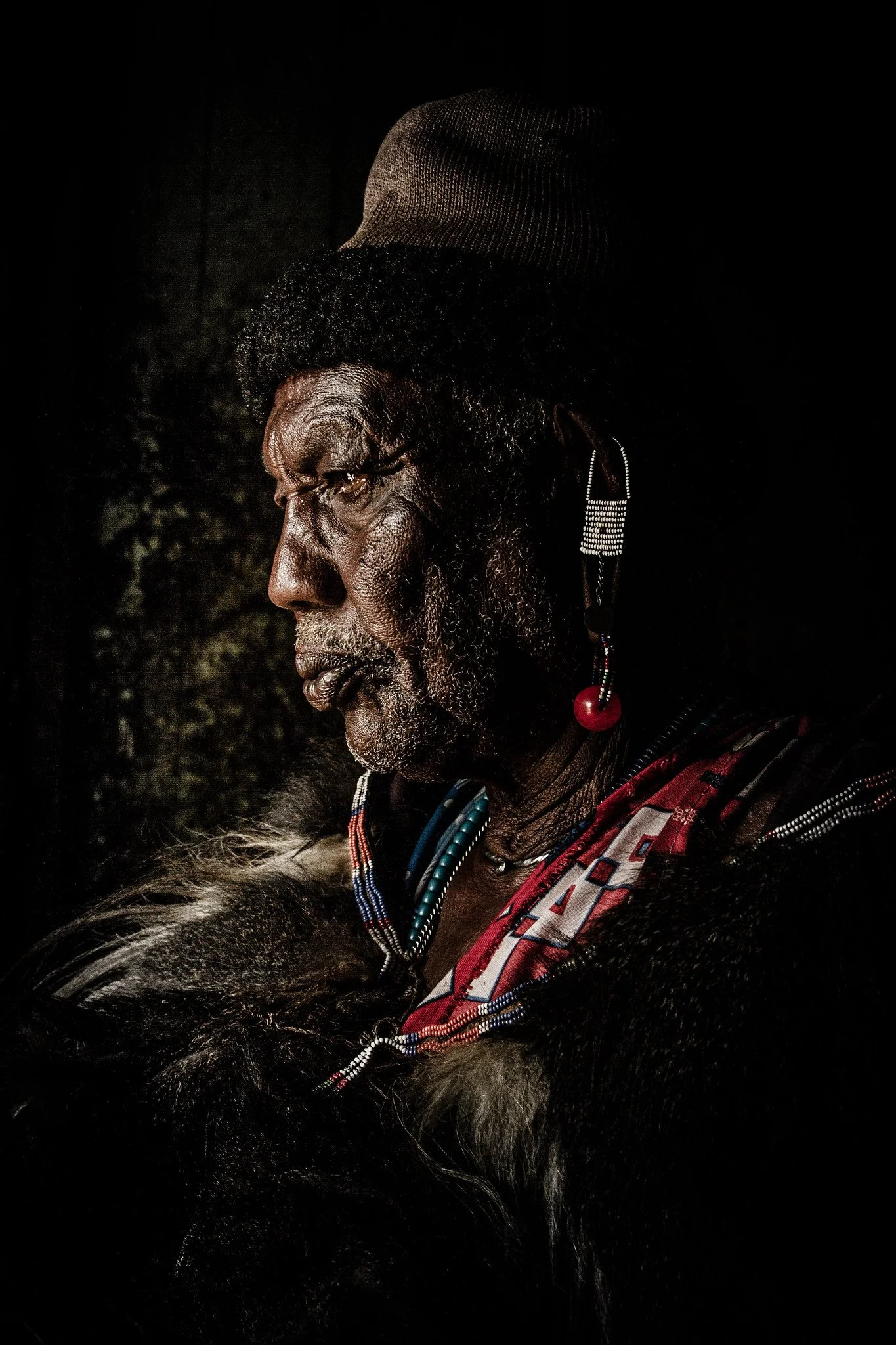
Mokompo, the great Maasai Laibon, lives in a remote corner of the Loita Hills where we conduct thrilling walking safaris with local Maasai guides.
A laibon is a spiritual leader, or a sage, and a person gifted with the power to see deep into the future. Despite this ability it would be incorrect to describe a laibon as a mere fortune teller and they’re certainly not witch doctors (though they do have great knowledge of the medical properties of the plants around them). Instead, they’re the ones who offer advice to an individual, or the community as a whole, on the best course of action to take in a given situation. For example, in times of drought, they can advise on where to find better grazing for the livestock. They can also mediate in community disputes. And, in the past, they were the ones who told the Moran (Maasai warriors) when and where to launch a cattle raid on neighbouring (non-Maasai) communities. Historically there are few more respected members of the Maasai community. Of all the laibon, none are more important than Mokompo. The powers of the laibon are hereditary (though only from father to son) and the powers run thicker in Mokompo’s blood line than in any other Maasai family. After all, it was his great-grandfather, Senteu, who predicted the arrival of the British in East Africa and the ‘iron snake’ (the railway running from Mombasa on the Indian Ocean coast of Kenya right through to Uganda). At the time of these predications, the Maasai were one of the dominant tribes in East Africa and Maasai moran were feared across the grasslands of much of East Africa. But, alongside his prediction of the arrival of the British, Sentu also foresaw the decline and fall of Maasai power. Unfortunately for the Maasai he couldn’t have been more right.
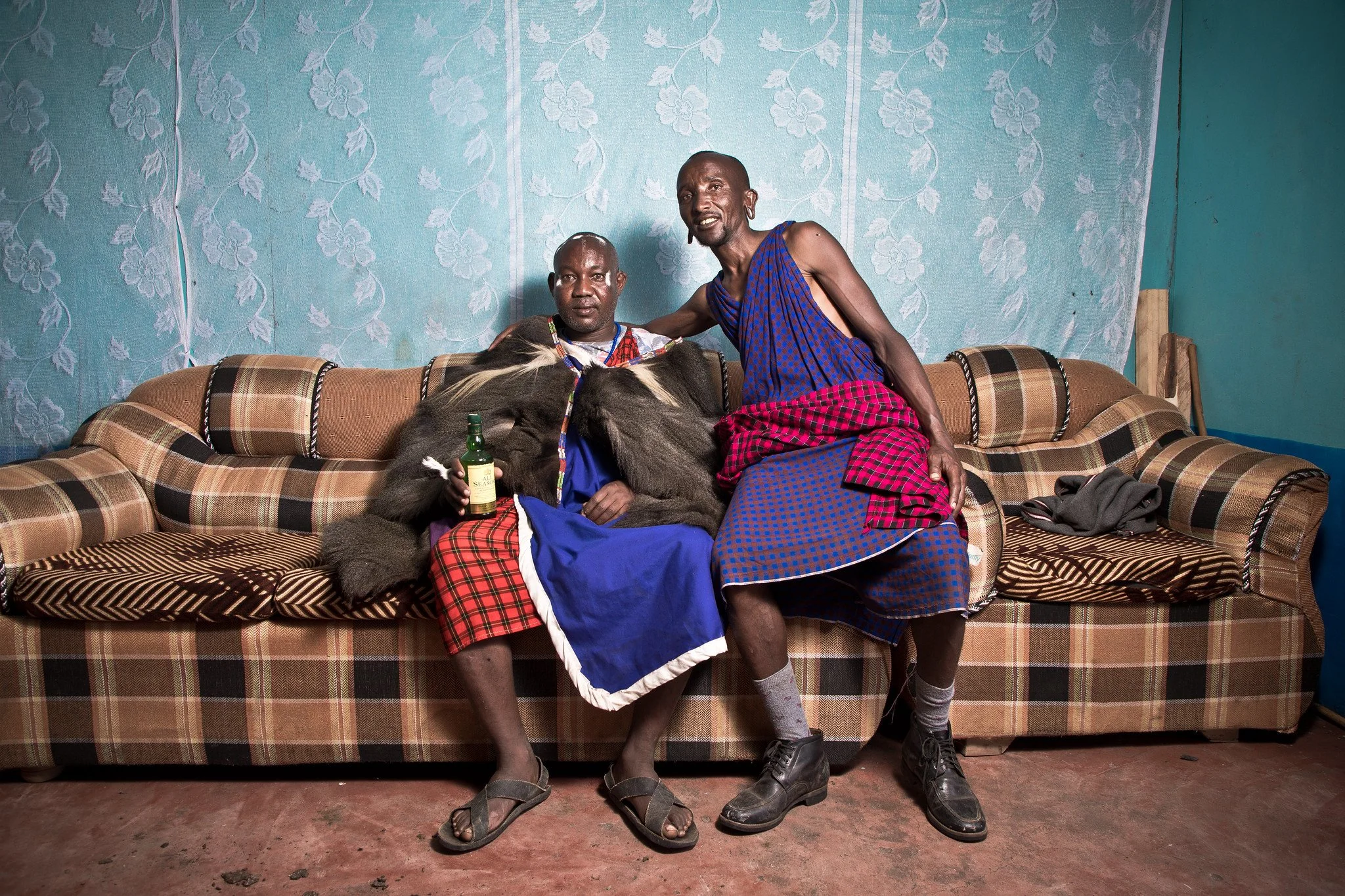
Mokompo’s son (on left) is poised to take over as the laibon after Mokompo.
I’d met Mokompo once before. Back in 2015 myself and two Maasai friends, Josphat Mako and Patrick Koyati, spent several weeks walking across a great swathe of southern Kenya. We’d chosen to walk rather than travel by vehicle because of the intimacy that striding across the African landscape provides. By walking we could see, smell, hear and touch the land. By walking we could observe and understand the landscape in a way that travelling by 4WD would never allow. Instead of watching wildebeest flash past a car window we could stop to marvel at the swinging movements of a praying mantis hunting a grasshopper. But more than that. By walking we came into closer contact with the people who lived on this land and knew it in a way that I never could. And for me, this had been the whole purpose of that earlier walk. We had met and chatted with shepherds and biologists, doctors and traditional healers, poachers and rangers. But, of all the people we had met none had stuck in my mind quite like Mokompo. Draped in a cloak of hyrax and colobus monkey fur, he had come across as a dignified and natural leader. Any question I’d asked had been thrown back at me with a counter question or an answer that could please all sides in an argument. Just before I’d left him he’d told me then that one day, after great events had changed the world, I would return to the forested glade in which he lives to seek the answer to an important question that nobody else would be able to answer.
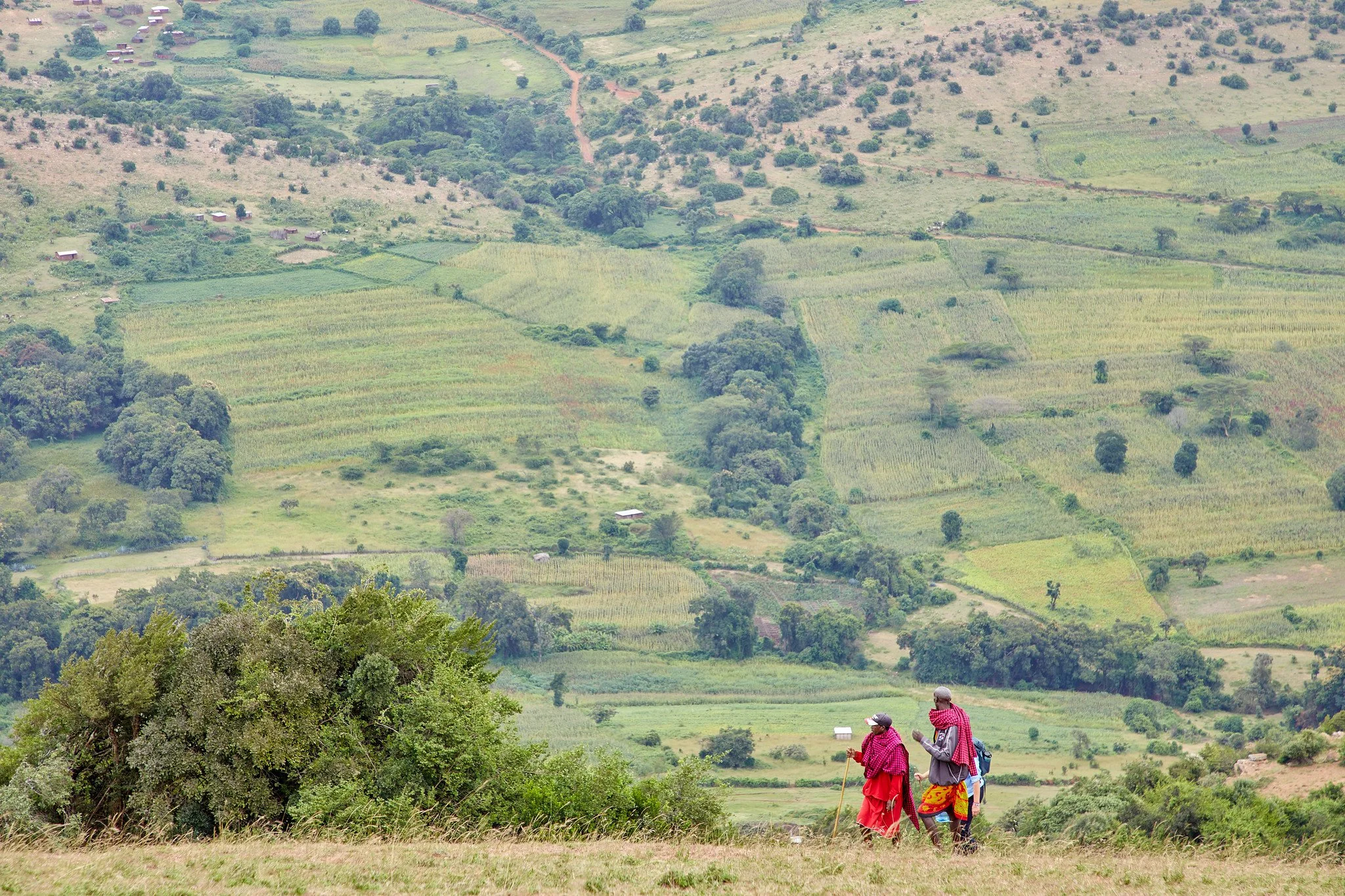
Patrick Koyati leading one of our Loita walking safaris.
Fast-forward seven years and I was back in southern Kenya in a world that was much changed from when I’d last met Mokompo. And I had a question for him. It was one that nobody else had been able to answer. And so, as in the predication, I once again set out with Maasai friends to find Mokompo. Again, we travelled on foot and spent the nights camped in woodlands and in the compounds of acquaintances of my Maasai friends. From the edge of the Masai Mara National Reserve, we paced our way eastwards over scrubby hills that quickly become greener hills and through valleys that became increasingly wooded until the environment and wildlife that we all so immediately associate with the great plains of East Africa had turned into something that was more akin to jungle. And then, after a few days of walking, we reached a stand of giant fig trees nestled under which was the homestead of Mokompo.
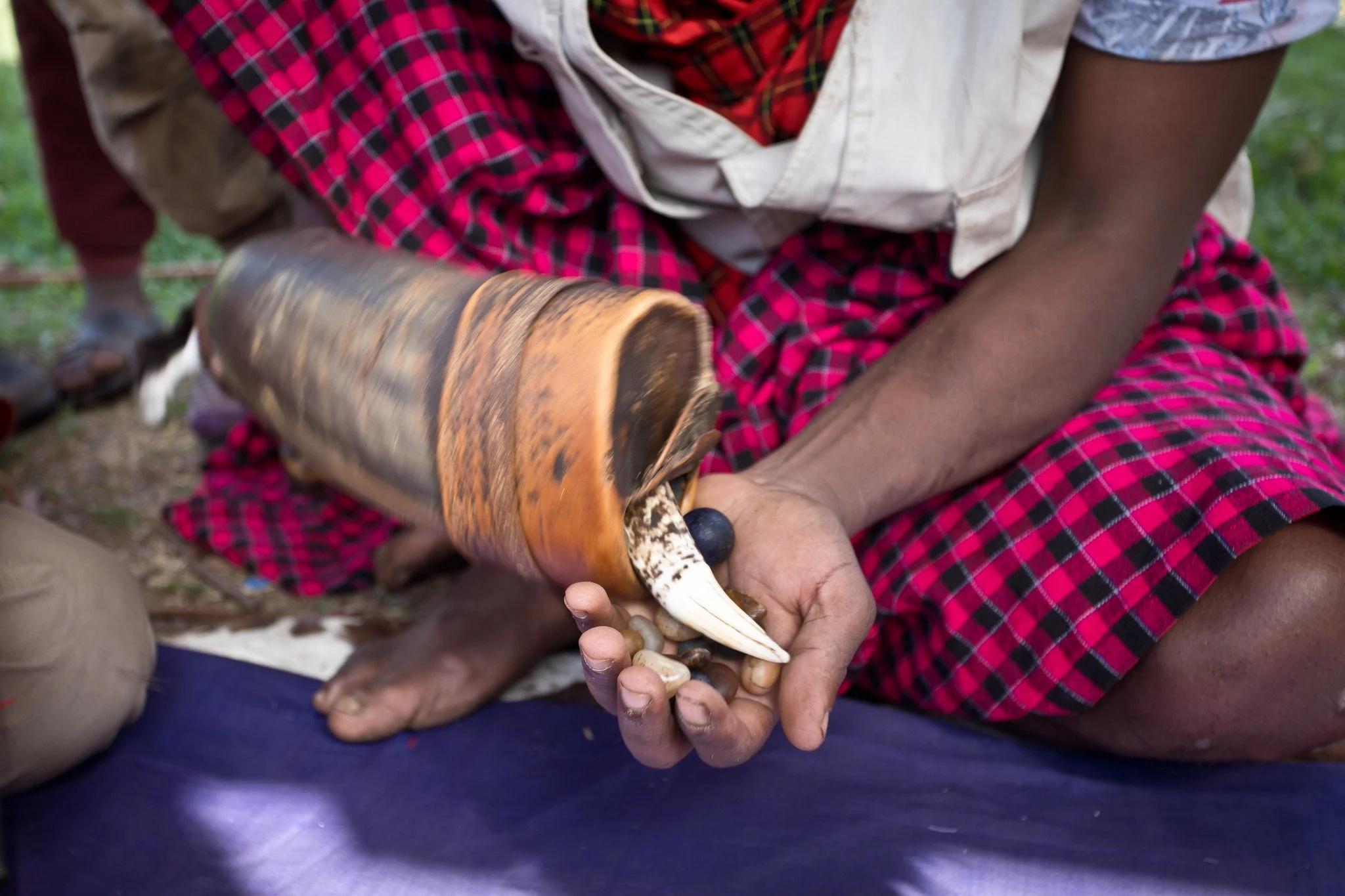
Reading the patterns from the ox horn oracle.
He didn’t seem at all surprised to see me. In fact, he barely acknowledged me. After questioning my Maasai friends on where they’d come from, he turned his attention to me. “So, you have returned” he said simply, “The foreigner has a question” he said to nobody in particular. And with that he called for one of his sons to fetch his ox horn oracle.
Mokompo sat in silence for a moment contemplating the patterns and orders in how the the stones, marbles and the lion tooth and claw had fallen onto the goat skin. Eventually though, he lifted his face to meet my expectant eyes, “Yes, it will be” is all he said and all I needed him to say.
This story orginally appeared in the UK’s i newspaper in June 2022. It was written by the founder of Samgai Journeys, Stuart Butler. The original version can be read here: https://inews.co.uk/inews-lifestyle/travel/meet-the-maasai-see-future-kenya-national-reserve-safari-1669112?srsltid=AfmBOopRxrAGq31iuvWeO_dSS6bLMRSxH_8UqZ09E-9d1oLMhz9A3B9r